


Mastering RoR in Coffee Roasting to Prevent Crash and Flick
A roast can look fine on the surface and still taste flat, bitter, or baked in the cup. Often, the problem is not the final temperature. It is the path the beans took to get there.
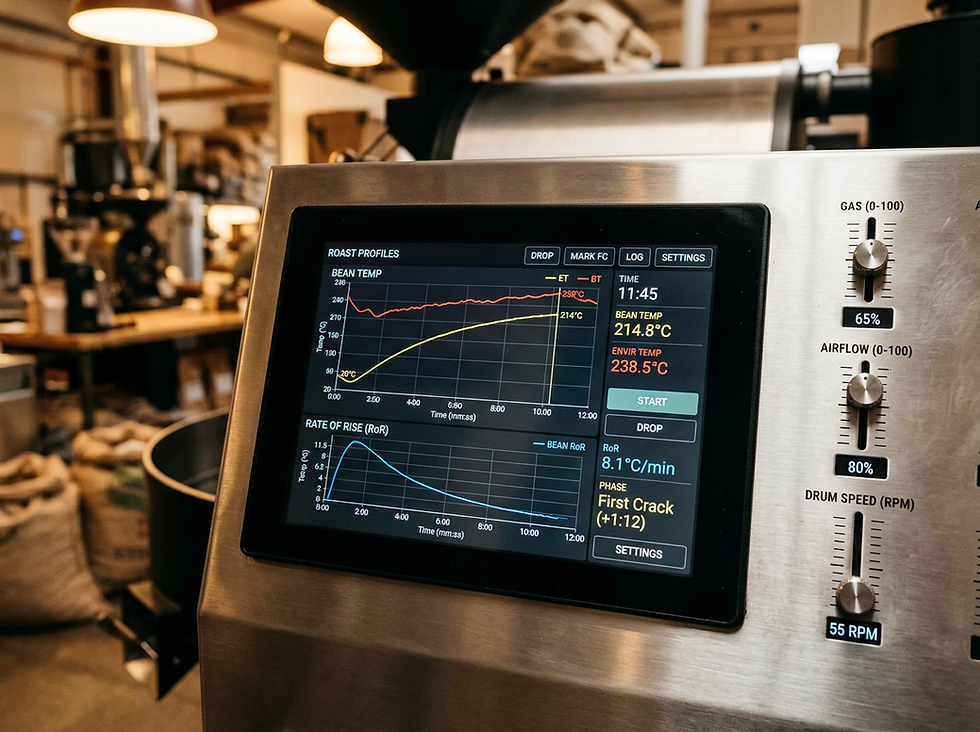
That path is where Rate of Rise, usually shortened to RoR, becomes one of the most useful readings in coffee roasting. RoR shows how quickly bean temperature is rising, usually in degrees per minute. If bean temperature is the “where are we now” reading, RoR is the “how fast are we moving” reading.
For a roaster, that makes RoR the closest thing to a speedometer. It tells whether the roast is gaining heat smoothly, slowing down at the right time, or heading toward two common defects: the Crash and the Flick.

RoR shows the real pace of the roast
RoR measures how much the bean temperature changes over a set time period. In its simplest form:
`RoR = current bean temperature - bean temperature one minute ago`
If the bean temperature was 320°F one minute ago and is now 335°F, the RoR is 15°F per minute.
That number matters because roasting is not just about reaching a target temperature. It is about controlling how fast chemical and physical changes happen inside the bean. Sugars brown. Acids transform. Moisture leaves the seed. Aromatic compounds form and break down. The speed of heat application affects all of these changes.
A high RoR means the roast is moving quickly. A low RoR means the roast is slowing. Neither is automatically good or bad. Context matters.
Most professional roast profiles aim for a steadily declining RoR. The roast starts with strong heat momentum, then gradually slows as it moves through drying, browning, first crack, and development. This falling curve helps the coffee develop sweetness and aroma without stalling or scorching near the end.
Think of RoR as the cooking speed of the coffee bean. A skilled cook does not leave the heat unchanged from start to finish. The heat is adjusted as the food changes. Coffee works the same way, only faster and with less room for error.
RoR is especially useful because it warns the roaster before the cup shows the problem. A sudden dip or spike late in the roast often leaves a clear taste signature. Once that flavor defect appears, it cannot be fixed after roasting.
A healthy RoR curve declines with control
The ideal RoR curve is not perfectly smooth in real life. Thermocouples lag. Airflow shifts readings. Beans release steam. First crack creates noise in the data. Software smoothing can make the curve look calmer than the roast actually was.
Still, the overall direction should be clear: high early, lower later, with no sudden cliff or jump near the end.
A typical roast profile moves through three broad stages.
The early stage builds momentum
At charge, the beans enter a hot drum or roasting environment. The bean probe reading usually drops at first because the cooler beans absorb heat. This is the turning point phase.
After the turning point, RoR climbs because the beans are gaining heat quickly. This early energy matters. If the roast starts too weak, the coffee may struggle to build sweetness later. If it starts too aggressively, the outside of the bean can take on too much heat too soon.
The goal is controlled momentum, not maximum speed.
The middle stage shapes sweetness and structure
As the roast moves through drying and into browning, Maillard reactions build color, aroma, and body. RoR should start to fall in a measured way.
This is where heat decisions become more delicate. Large gas changes can create unstable curves. Too much heat may push the coffee too hard into first crack. Too little heat may make the profile stall.
A smooth decline gives the roast enough energy to keep developing while avoiding harshness.
The final stage protects flavor clarity
Near first crack and development, the coffee is more sensitive. The beans are exothermic for part of this phase, meaning they release heat as internal reactions accelerate. The roaster must manage stored heat carefully.
This is where the two most damaging RoR mistakes often appear.
A clean finish keeps RoR declining without dropping to zero and without rising sharply again. This takes planning. Heat changes made late in the roast may show up too slowly to help, while heat stored in the roasting system can keep pushing the beans even after the burner is reduced.
Crash and Flick are small curve changes with big flavor costs
The Crash and the Flick are not abstract graph problems. They show up in the cup.
A roast can finish at the same end temperature and development time as another roast, yet taste completely different because the RoR curve behaved differently in the final stage. That is why Mastering RoR in Coffee Roasting to Prevent Crash and Flick is less about chasing a pretty graph and more about protecting the flavor work already built during the roast.

A RoR Crash stalls development
A RoR Crash happens when the rate of temperature rise drops suddenly near the end of the roast. In severe cases, RoR approaches zero. The roast is still technically hot, but the beans are no longer gaining heat at a healthy pace.
Common causes include:
Reducing heat too sharply before or during first crack
Applying too much cool airflow late in the roast
Failing to account for a sudden release of steam and energy
Making a correction based on panic rather than trend
The flavor result is often described as baked. The coffee may taste flat, woody, papery, or dull. Sweetness can feel muted. Acidity may lose definition. The cup may seem cooked but not properly developed.
This happens because the roast loses momentum during a critical phase. Chemical reactions continue, but without enough energy flow to progress cleanly. The beans spend time in heat without developing the lively flavors expected from a controlled roast.
A Crash is especially frustrating because it often happens after the roast has been going well. The curve looks controlled, first crack begins, then the roaster cuts heat too hard. The RoR falls off a cliff. The final color may look normal, but the cup tells the truth.
A RoR Flick creates harshness late in the roast
A RoR Flick is the opposite problem. It happens when RoR rises suddenly near the end of the roast, often after first crack has started or near the final development window.
Common causes include:
Reducing heat too late
Carrying too much stored energy into first crack
Using insufficient airflow before heat builds up
Responding to the roast only after the curve has already turned upward
The flavor result can include bitterness, roastiness, smoky notes, or a scorched edge. In lighter roasts, a Flick can distort clarity. In darker profiles, it can push the cup toward burnt or ashy flavors faster than expected.
The Flick is dangerous because it can happen quickly. Heat stored in the drum, airflow path, and bean mass keeps moving into the coffee. Even if the burner is reduced, the system may still have enough momentum to force RoR upward.
A Flick often means the finish was not planned early enough. The roaster waited until the roast looked too hot, then reacted. By then, the beans were already carrying too much heat.
Better RoR control starts before first crack
Preventing Crash and Flick does not come from one heroic adjustment at the end. It comes from planning each heat and airflow change before the roast demands it.
The best RoR control starts with consistent inputs.
Keep charge conditions repeatable
If charge temperature, batch size, green coffee temperature, or drum heat changes from roast to roast, RoR will be harder to read. The curve may look different because the starting conditions changed, not because the coffee needs a new strategy.
Good tracking includes:
Batch weight
Charge temperature
Environmental temperature if available
Turning point time and temperature
Gas or power settings
Airflow changes
First crack start time
Drop time and temperature
Consistency makes the curve meaningful. Without it, the roaster ends up comparing unrelated profiles.
Make heat changes early enough to matter
Roasting systems have lag. A gas reduction may not change bean temperature instantly. Airflow changes can also take time to show in the curve.
This is why late corrections cause trouble. Waiting until RoR is already crashing or flicking leaves little room to recover.
A better approach is to watch the trend. If the curve is falling too quickly before first crack, reduce the size of the next heat cut or delay it slightly. If the curve is flattening too high and first crack is near, reduce heat earlier so stored energy does not push the roast into a Flick.
Small planned changes often beat large late changes.
Treat airflow as a heat and moisture tool
Airflow does more than remove smoke. It changes convective heat transfer and affects how moisture leaves the roasting chamber.
Too much airflow late in the roast can cool the environment and contribute to a Crash, especially if paired with a major heat reduction. Too little airflow can trap heat and smoke, which may raise the chance of a Flick or create heavier roast flavors.
The right airflow strategy depends on the machine, batch size, and coffee. Still, the principle stays the same: airflow changes should support the RoR curve, not shock it.
Read RoR with smoothing in mind
RoR data can be noisy. Many roasting programs apply smoothing to make the curve easier to interpret. This helps, but it can also hide fast changes.
A very smooth curve may look calm while the real temperature movement is already shifting. A very sensitive curve may overreact to probe noise.
The goal is not to worship the line. The goal is to use RoR as a practical guide along with smell, sound, color, and time. First crack behavior, aroma changes, and bean color still matter.
Rostino AI helps prevent human timing errors
Manual roasting rewards skill, but it also exposes the roaster to timing errors. A few seconds of delay can matter near first crack. A heat cut made too aggressively can cause a Crash. A heat cut made too late can allow a Flick.
Rostino AI is designed to reduce these risks by predicting the likely temperature path from the current trend. Rather than waiting for the curve to misbehave, the control system can adjust the heat source automatically to keep the RoR moving along the intended decline.
That matters most during complex profiles. Some coffees need a gentle finish to preserve floral notes. Others need enough late-stage energy to build body and sweetness without tasting baked. A human roaster can design that path, while automatic control helps execute it with fewer moment-to-moment mistakes.
The value is not that AI replaces roasting knowledge. It gives the roaster steadier control over the most sensitive parts of the profile. The expert still chooses the goal. The system helps protect the curve from sudden drops and spikes.
For production roasting, this also supports consistency. If the same coffee needs to be roasted repeatedly, the difference between “close enough” and “cleanly repeated” often lives in the RoR curve.
The takeaway is simple and demanding
RoR is the roast’s speed. When it falls in a steady, controlled way, the coffee has a better chance to develop sweetness, aroma, and balance. When it crashes, the cup can turn flat and baked. When it flicks, bitterness and burnt notes can take over.
The practical goal is clear:
Build enough early momentum
Guide the curve downward through the middle stage
Plan heat and airflow changes before first crack
Avoid sudden late-stage corrections
Use tools like Rostino AI to hold the intended curve with greater precision
A good roast is not only about where it ends. It is about how smoothly it gets there. Control the RoR, and the final cup becomes far more predictable.


Comments